

Sulfate-free and other free-from labels
What these label words do and do not tell you.
Disclosure: We may earn a commission if you buy through links on this page. It does not change our guidance. Affiliate Disclosure
"Sulfate-free" is the maker's term
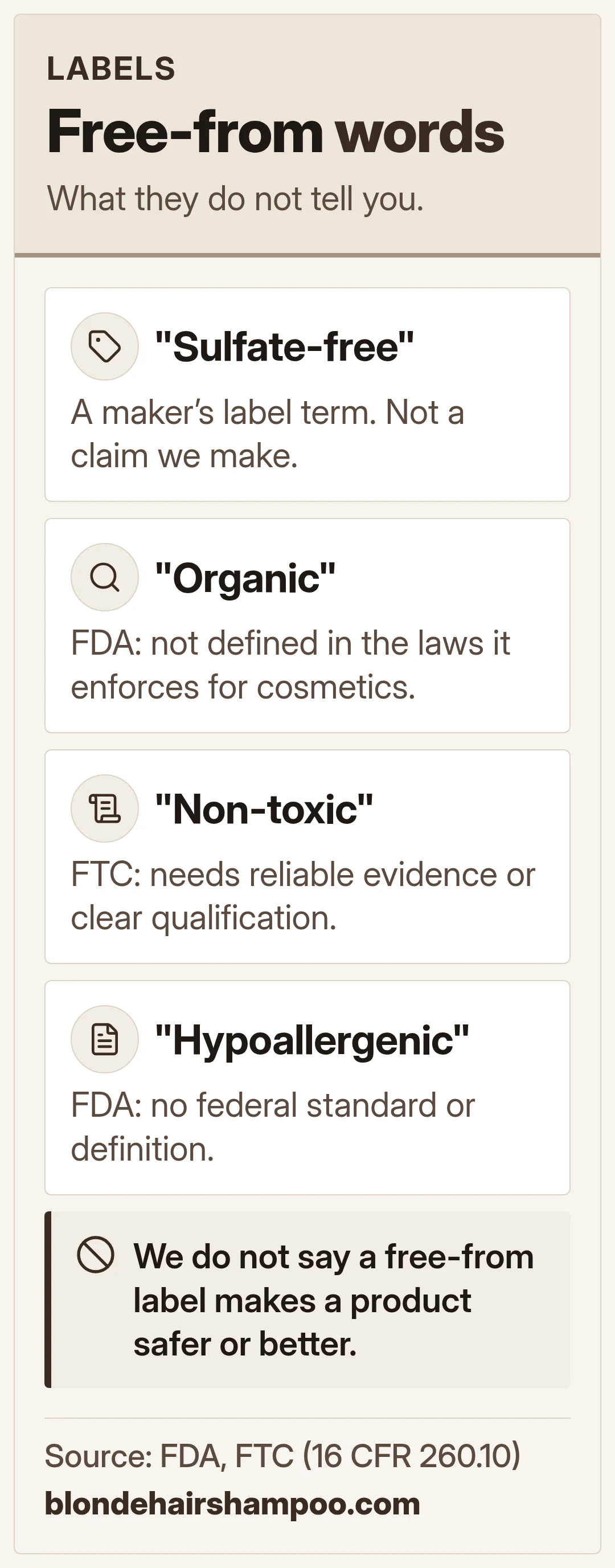
"Sulfate-free", "paraben-free", and similar words are label terms a maker uses. We do not say a free-from label makes a product safer or better. The ingredient list, which the FDA requires, shows what is in the product.
"Organic"
The FDA says the term "organic" is not defined in the laws it enforces for cosmetics, and that the U.S. Department of Agriculture oversees the National Organic Program. Asked whether cosmetics made with organic ingredients are safer, the FDA answers "No," and says "an ingredient's source does not determine its safety."
"Natural" and "clean"
We have found no FDA definition of "natural" or "clean" for cosmetics. We do not say a "natural" or "clean" label makes a product safer or better.
"Non-toxic"
FTC rules at 16 CFR 260.10 say a non-toxic claim "likely conveys that a product, package, or service is non-toxic both for humans and for the environment generally," and that marketers making one should have competent and reliable scientific evidence or clearly qualify it. We do not call any product non-toxic.
"Hypoallergenic"
The FDA says "there are no Federal standards or definitions that govern the use of the term 'hypoallergenic.'" It says the term means whatever a particular company wants it to mean.
One rule for all cosmetics
The FDA says cosmetics must be properly labeled and must not be adulterated, and that companies are responsible for the safety and labeling of their products and ingredients.
FAQ
General information, not medical advice. Follow the label. We suggest testing a new hair product on a small patch of skin first. Keep it out of your eyes, and stop use if irritation occurs. For hair dye, the FDA says to do a patch test every time and never to dye your eyebrows or eyelashes. See a doctor or dermatologist about scalp problems or hair loss.
Next: reading labels
Order, colors, fragrance.
